

U.V.S. Nirmana
Reflecting on a puzzle game.

I haven’t written in some time. Some of that is life demanding I hold down a job, vapourising my energy, but mostly it’s the repetitive strain injury inflicted to my wrists and shoulders making it physically painful to to play and write about games. I still feel a constant need to write, and have passion for interesting or unusual games, so, despite considerable pain, this essay crystallised over the weekend I played U.V.S. Nirmama.
U.V.S. Nirmama is a 2026 puzzle game from Coincidence.1 It’s a self-described “Zach-like”, reminiscent of, and created by former developers from, the studio Zachtronics. I’ve discussed their solitaire minigames, and visual novel Eliza, previously. To me, U.V.S. Nirmama is a great example of how strong theming can elevate a game beyond raw mechanics.
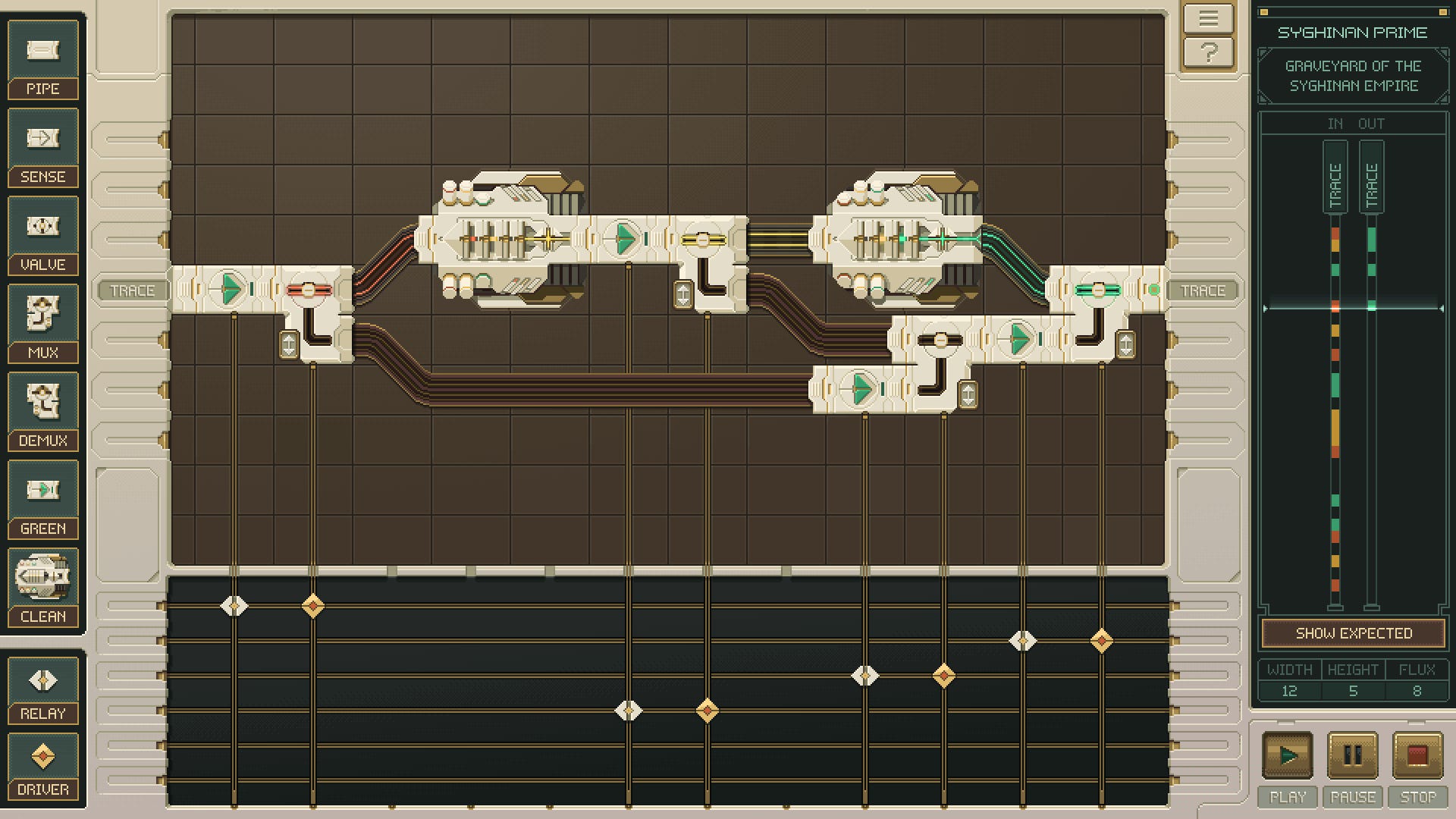
Talking nuts and bolts, the gameplay of U.V.S. Nirmama is much the same as other “Zach-likes”. It is an open-form puzzle game, each level an empty field with inputs on the left and outputs right. You, the player, transform one into the other by building a machine in the space between, using a selection of tools that expands as the game progresses. The format expects you to experiment, combining tools in new ways to create unexpected solutions.2
It’s a mature style, one I enjoy very much, and the current iteration reminds me of Opus Magnum. In U.V.S. Nirmama the puzzles are reminiscent of building pipes to redirect water. The first level is as simple as connecting three inputs to their outputs, while the second involves using a sensor to control the flow through one pipe based on the flow through another. However, rather than control water, you’re altering the flow of prāna to rematerialise the missing crew of a vacant space station.
U.V.S. Nirmama is framed aroung a sci-fi journey across a Buddhism infused universe3 abord the good ship Nirmana. Framing radically shifts the player’s perception of the puzzles; to me, it was like being Geordi La Forge aboard the Enterprise-D, if that ship were also a monastery. The framing of missions is as fantastic as TNG or DS9, like “Wakish Prime - Hostile Alien Homeworld” where you are tasked with overcoming alien “antimemetic” shield technology. This is done by making the shield observe itself, and the mission briefing comes with the suggested mediation
“When antimemes are made to observe themselves, what exactly is observed? Who or what is doing the observing?”
All missions come with mediations, and I love this little detail; the crew are monks, not just dressed in robes. We know from the Nirmana’s sister-ship, the Nayuta, that she is a sky-bourne monastery, so of course it follows that the engineering section would act like they are in a monastery. I value that effort has gone into consistent theming, rather than a thin aesthetic smear over an otherwise generic sci-fi setting.
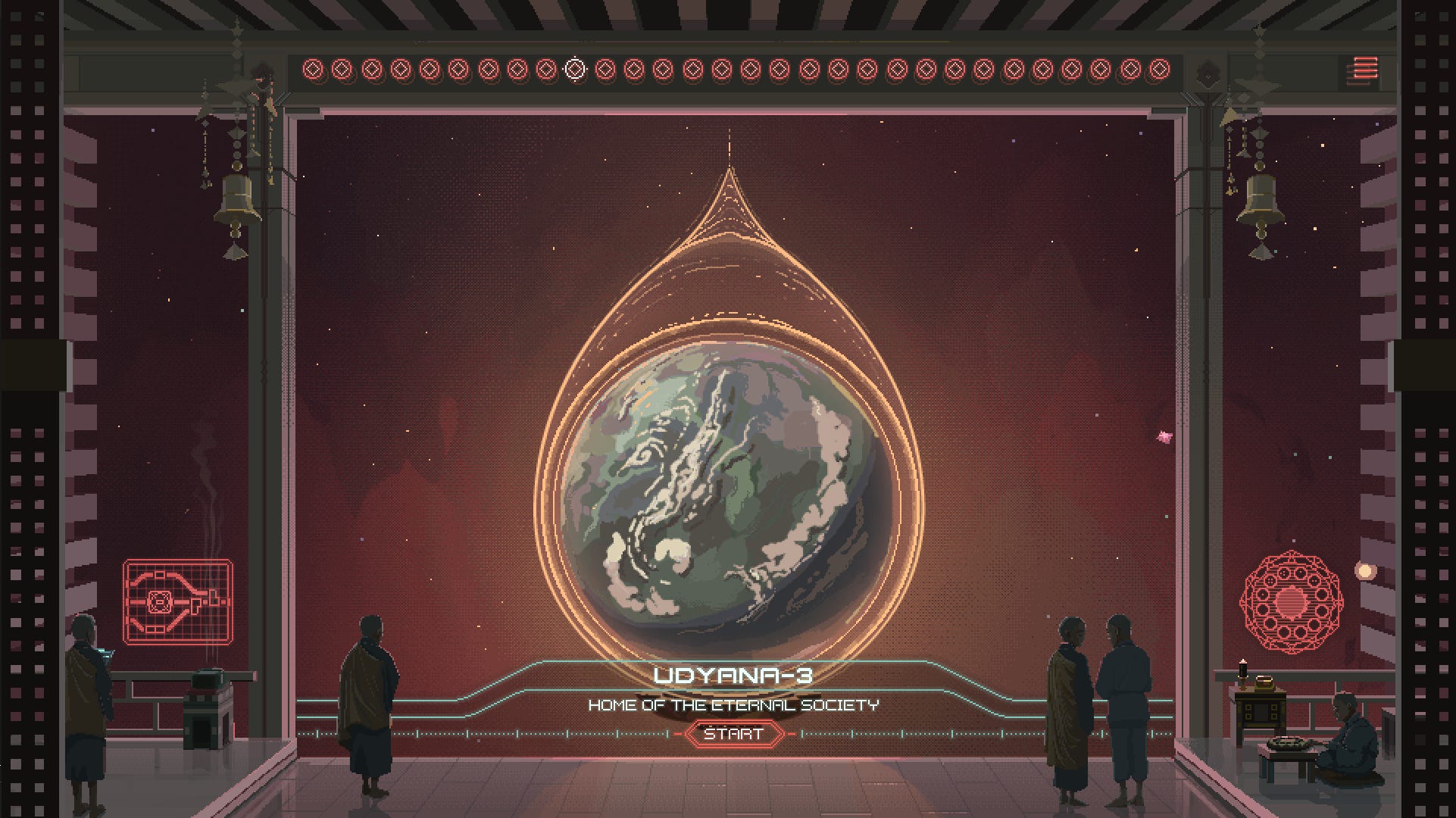
On that note, I adore the visual design. The puzzle select screen is, presumably, the birdge of the Nirmana (what’s the bridge of a monastery?). Robed monks maintain smoking incense and consult holographic tablets, all painted in mute shadows so not as to distract from the blazing vista that comes at you like a shouted greeting. Space stations, planets, and anomalies glow so bright that the rest of the scene may well be burnt to ash. Selecting a mission shifts the ship to a new location, causing a low rumble and blinding flash from the Nirmana’s engines. The prayer bells chime softly as the ship settles back down. Like the colour palette the music is at once dark, muted, but will ignite to brigthness as a tungsten fillament burning out. In it’s angular and synthetic waveforms I hear the detailed yet discernable pixels of the visual design.
One could criticise the game by saying everything but the mechanics is so light as to be illusory.4 Mission briefings don’t inform gameplay, and converting prāna to apāna is functionally turning green to red, however, this entirely misses the point. I would not enjoy the puzzles of U.V.S. Nirmama to the same extent if seperarted from the aesetics. Games are a uniquely hollisitic medium; you may as well seperate the letters from the writing. What does sadden me is that I have little reason to revisit the Nirmana, and that I only found the final three puzzles challenging. It never felt like we reached a mechanical climax, but perhaps that is because the game taught me effectively.
Even though I likely won’t see the soft vistas of space from the Nirmana’s bridge again, I enjoyed my time with it for the puzzles and presentation, and for the opportunity to write. I intend to hold the experience lightly until I no longer need it, then surrender it to the summer breeze.
This work is licensed under CC-BY-SA 4.0
Send me a tip on Ko-fi?
Coincidence is the… successor studio to Zachtronics? I’m not entirely sure, but U.V.S. Nirmama was made by the creators of games such as Opus Magnum.
It’s essentially physical programming, building logic gates.
I’m no expert on Buddhism, and my research for this essay was nessecarily brief, so my apolgies for the surface-level dicussion of the topics. I’d like to read a more in-depth take!
And I didn’t enjoy the mancala solitaire minigame, but that’s because mancala has far too much counting for my taste. Kudos for moving beyond card soliatire.